Derivatives
Study Material:
Introduction:
The derivative of a
function of real variable  measures the sensitivity to change of function
value with respect to change of its argument.
measures the sensitivity to change of function
value with respect to change of its argument.
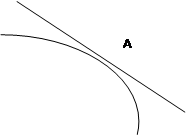 For
example, the derivative of the position of a moving
For
example, the derivative of the position of a moving
 Point with respect to time is the
velocity of that point.
Point with respect to time is the
velocity of that point.
Derivative
can be generalized to functions of several variables.
The
processing to find the derivative is called differentiation.
Definition:
Let  be a real valued function and
  be any point on its domain. Then the
derivative of at
be any point on its domain. Then the
derivative of at  is denoted by
  and defined by
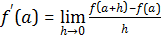 ,
provided this limit exists.
,
provided this limit exists.
Or
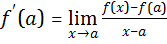 ,
provided this limit exists.
,
provided this limit exists.
To find the derivative of at any arbitrary point  is given by
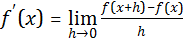
This
definition of derivative is also called the first principle of derivative.
Remark:
There are different
notations for derivative of a function. The derivative of ,  is denoted by
  or
or  or D
or D . Also
the derivative of at the point is denoted by
. Also
the derivative of at the point is denoted by 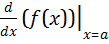 or
or 
Example:
Find the derivative of  at
arbitrary point
at
arbitrary point 
Solution:

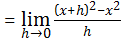
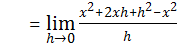
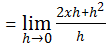
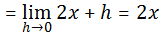 .
.
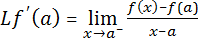
Left hand derivative:
The left hand derivative
of a real valued function at is denoted by  and is defined by,
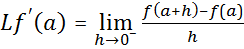
or
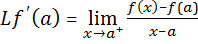
Right hand derivative:
The right
hand derivative of a real valued function at is denoted by  and is defined by,
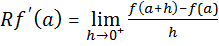
or
Note:
The
derivative of a function exists if and only if its left hand derivative and
right hand derivative exist and equal that is  exists if and only if
  .
.
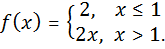
Example:
Find the left hand derivative and right hand derivative of the given function
at 
Solution:
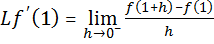
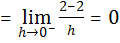
And 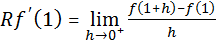
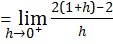

 .
.
Geometric representation of derivatives:
Let us consider a curve and draw a tangent of the curve at the point  which makes an angle
  with the
  - axis.
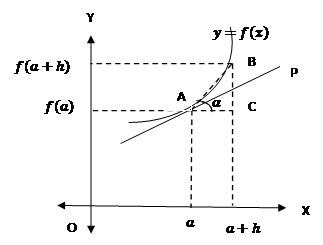 Let
Let  be another point very close to the point
 . Add
the points A and B.
. Add
the points A and B.
Let
 .
.
Then from
the  ABC,
ABC,
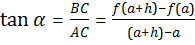
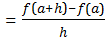
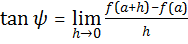
Now, from the figure we say that when B A that
is when the point B moves toward the point A, then
A that
is when the point B moves toward the point A, then  unboundedly decrease and approach to
  and the line AB will approach to the tangent
AP. Then
and the line AB will approach to the tangent
AP. Then
i.e., 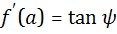
Algebra of derivative of functions:
Let and  be two functions whose derivatives are defined
in a common domain. Then
be two functions whose derivatives are defined
in a common domain. Then
1. Derivative of sum of two functions is
the sum of the derivatives of that two functions. That is

2. Derivative of difference of
two functions is the difference of the derivatives of that two functions. That
is

3. Derivative of product of two
functions is the product of the derivatives of that two functions. That is

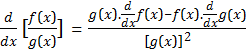
4. Derivative of quotient of
two functions is the quotient of the derivatives of that two functions
(whenever the denominator is non-zero). That is
 .
.
Note:
In
particular if we take , where
 is a constant then the formula 3 formed as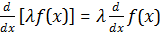
Remark:
if
 and
and  , then
the above equations can be written as
, then
the above equations can be written as
1.
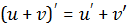
2.
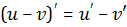
3.

4.
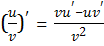 Respectively.
Basic formulas of derivatives:
General
derivative formulas:
1.  , where
 is any constant.
2. 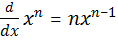 , where
 is positive or negative integer. This is
called power rule of derivatives. In particular if we take
is positive or negative integer. This is
called power rule of derivatives. In particular if we take  , then
  .
.
3.  , where
is any function. This is called the power rule
for functions.
, where
is any function. This is called the power rule
for functions.
Derivative
of logarithm functions:
1.

2.
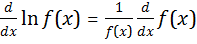
3.
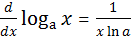
4.

Derivative
of exponential functions:
1.

2.
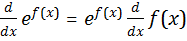
3.
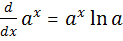
4.

5.
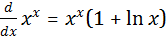
Derivative
of trigonometric functions:
1.
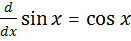
2.
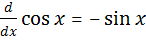
3.
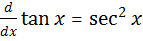
4.
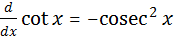
5.
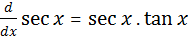
6.

Derivative
of hyperbolic functions:
1.
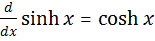
2.
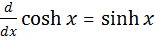
3.
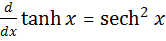
4.
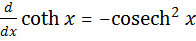
5.

6.

Derivative
of inverse trigonometric functions:
1.

2.

3.
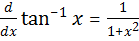
4.

5.

6.

Derivative
of hyperbolic functions:
1.
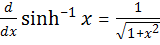
2.
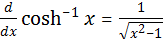
3.

4.

5.

6.
 .
.
Example
1: Prove that derivative of  is
is  .
.
Proof: Let  then
then
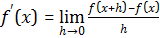
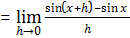
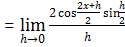
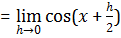 .
. 
 (Proved).
Example
2: Compute the derivative of 
Solution:


 .
.
Solutions of the exercises of NCERT book
1.
Find the derivative of  at
at  .
.
Solution:

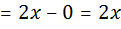
Therefore the
 .
.
2.
Find
the derivative of at .
Solution:
 .
.
So the
derivative of at  is
is .
.
3.
Find
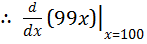
the derivative of  at
at .
.
Solution:
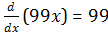
 .
. 
4.
Find the
derivative of the following functions from first principle.
i).
Solution:
Let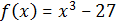 .
.
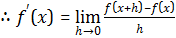
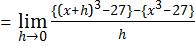

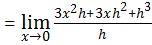
 .
.
ii) 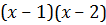
Solution:
Let  .
.
|
|
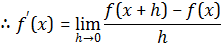

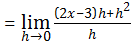
 .
.
iii). 
Solution:
Let 
|
|
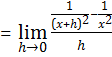
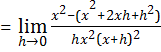
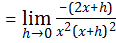
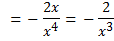 .
.
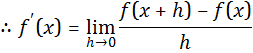
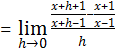
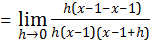
iv) 
Solution:
Let 
|
|
 .
.
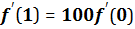
5.
For the
function  . Prove that
  .
.
Proof.
Here 

|
So, |


And  .
.
Hence 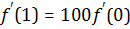 .
.
6.
Find
the derivative of  , for some real number
  .
.
Solution:


|
|




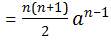 .
.
7.
For
some constant and  find
the derivative of
find
the derivative of
(i)
Solution:



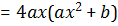
(ii)

Solution:


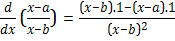
(iii)

Solution:

8.
Find
the derivative of  for
some constant.
for
some constant.
Solution:



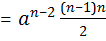
So, 

9.
Find
the derivative of
(i)

Solution:

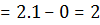 .
.
(ii)

Solution:



 .
.
(iii)

Solution:


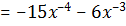 .
.
(iv)

Solution:

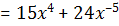 .
.
(v)
Solution:

 .
.
(vi)

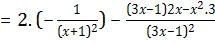
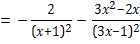
Solution:

10.
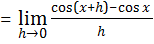
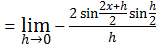
Find
the derivative of from
first principle.
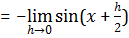
Solution:
Let
 then.
then.
|
|
 .
. 
 .
.
11.
Find
the derivative of the following functions:
(i)

Solution:

 .
.
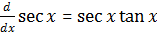
(ii)

Solution:
(iii)
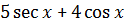
Solution:

 .
.
(iv)

Solution:
 .
.
(v)

Solution:

 .
.
(vi)

Solution:

 .
.
(vii)
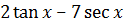
Solution:

 .
.
|
|
|

